Anima-2.9B: A 2.9B-Parameter Image Model Built for Anime and Illustration
Gazingstars123’s Anima-2.9B expands the original Anima architecture to roughly 2.9 billion parameters, targeting anime, illustration, and non-photorealistic image generation with newer training data, stronger prompt understanding, and support for ComfyUI and Forge-Neo.
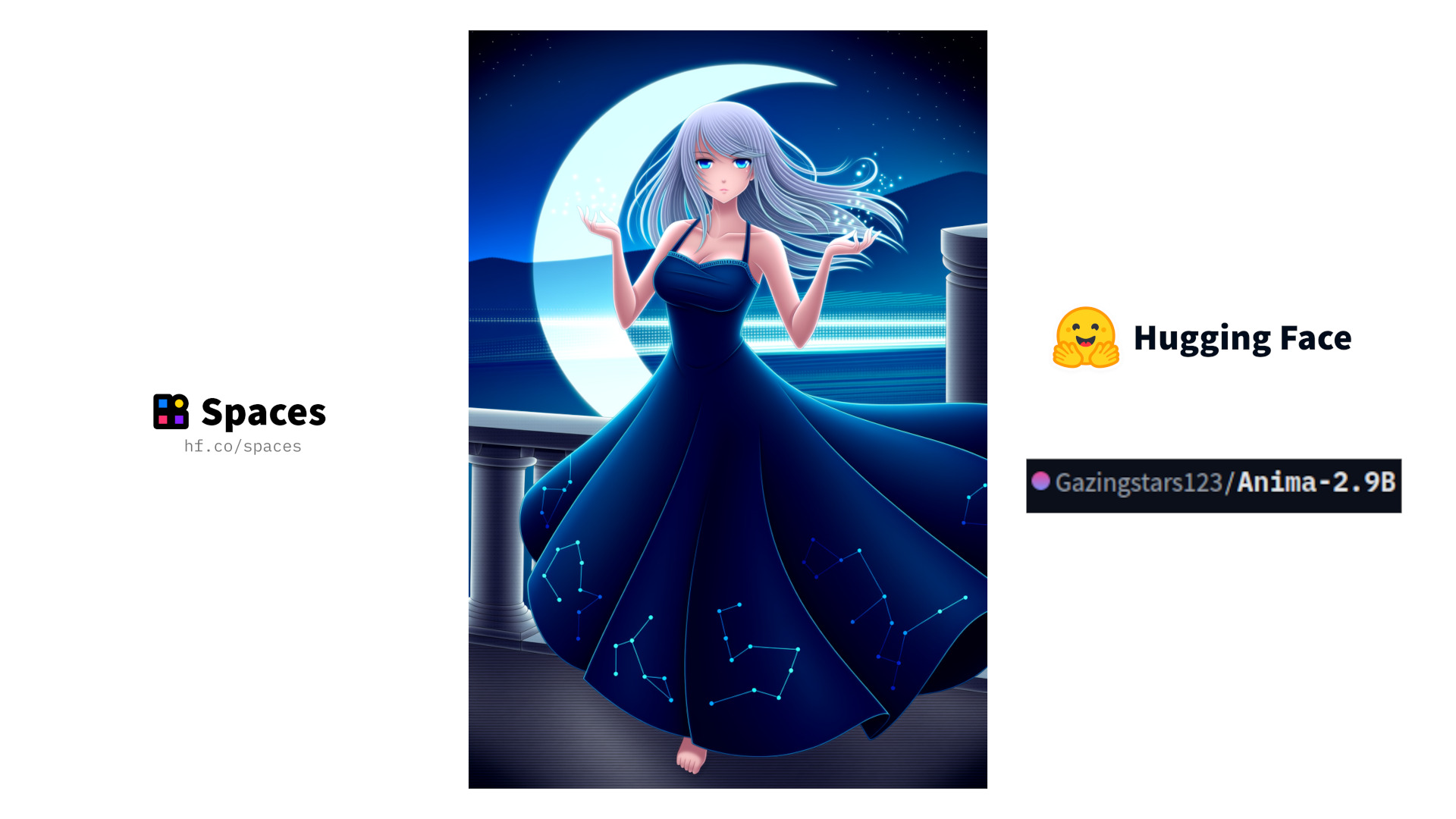
The race to build better image-generation models is not only about making models larger.
Sometimes the interesting progress comes from taking an already capable architecture, expanding it intelligently, and training it on more recent and carefully selected data.
That is the idea behind Anima-2.9B, a model from Gazingstars123 that builds on the original Anima project. The new release expands the architecture to roughly 2.9 billion parameters while focusing heavily on anime, illustration, and other non-photorealistic artwork.
According to the model card, Anima-2.9B is a fine-tune and layer-expanded version of the original Anima model. The additional training includes 1.7 million anime and illustration samples, with a knowledge cutoff of July 2026.
The result is a relatively compact text-to-image model designed for creators who want strong stylized image generation without relying entirely on enormous cloud-based systems.
A 2.9B-Parameter Model With a Very Specific Goal
Anima-2.9B is not trying to be a universal photorealistic image generator.
Its strongest focus is anime, illustration, characters, artistic compositions, and other non-photorealistic styles.
The model card describes the original Anima foundation as a model designed around anime, illustration, and artistic imagery, and Anima-2.9B continues in that direction rather than attempting to move toward general-purpose photorealism.
That specialization is important.
Image generators that target a specific visual style can devote much more of their training and prompting behavior toward the types of images their users actually want. For artists creating anime characters, game concepts, manga-inspired scenes, fantasy illustrations, or stylized portraits, that can be much more useful than having a model optimized for every possible visual category.
Anima-2.9B is therefore best understood as a specialized creative model rather than a direct replacement for every major text-to-image system.
Expanding Anima Instead of Starting From Scratch
One of the most interesting technical details is how the model was expanded.
The architecture was increased from 28 transformer layers to 40, bringing the model to approximately 2.9 billion parameters.
The model card describes a progressive expansion approach in which new layers are created by deep-copying neighboring layer weights. Their output projections are initially zeroed, allowing the expanded model to begin functionally similar to the original Anima before additional training.
This approach is connected to the broader idea of progressive block or layer expansion described in the LLaMA Pro paper.
Instead of simply replacing the original model with an unrelated architecture, Anima-2.9B extends the existing structure and then continues training it.
That makes the release particularly interesting from a model-engineering perspective.
It demonstrates another strategy for increasing model capacity without treating every new model as a completely independent training project.
1.7 Million Additional Training Samples
The updated model was trained on an additional 1.7 million anime and illustration samples.
The creator reports that the knowledge cutoff is July 2026, while the training dataset includes both newer and older material. The model card also states that roughly 70% of the compute for the preview version was spent training at 1024-pixel resolution.
That emphasis matters because image quality is not determined only by parameter count.
Training at higher resolutions can help a model learn more detailed compositions, character features, clothing, backgrounds, and other visual structures. For an illustration-focused generator, these details can have a direct impact on the final result.
The model was trained using the Muon optimizer on an 8× NVIDIA RTX 5080 cluster, with earlier training steps performed locally on the creator’s own PC.
The project therefore represents a fairly unusual combination of personal experimentation and relatively powerful multi-GPU training.
Built for Detailed Prompting
Anima-2.9B is designed to respond well to detailed prompts.
The creator recommends using quality tags, year or period tags, artist tags, character counts, character tags, series or copyright information, and descriptions of the subject’s appearance.
For example, instead of simply asking for:
anime girl
users are encouraged to describe the character, clothing, pose, environment, lighting, composition, artistic style, and other relevant properties in much greater detail.
The model card specifically warns that short prompts can produce relatively bland or simple backgrounds and may not fully express the intended result.
This makes Anima-2.9B a model where prompt construction can have a significant influence on output quality.
For creators who enjoy experimenting with prompting, that can be a major advantage.
Better Character and Multi-Character Prompting
Character generation is one of the obvious areas where an anime-focused model becomes useful.
The recommended prompting system includes character-count tags such as 1girl and 1boy, along with character names, series or copyright tags, and appearance descriptions.
The creator also recommends associating character names with the relevant series or copyright information because otherwise the model can confuse characters with similar names or visual traits.
Multi-character prompts require additional care.
Each character should be associated with its own attributes so that clothing, hair, colors, poses, and other properties are less likely to become mixed together.
This is a familiar problem in text-to-image generation, and Anima-2.9B’s prompting recommendations are clearly designed around reducing that type of ambiguity.
No Score Tags in the Dataset
Another interesting detail is that the dataset does not include score tags in its captions.
Some image-generation workflows rely on aesthetic or quality scoring information to influence how the model interprets prompts.
Anima-2.9B was trained without those score tags.
The creator notes that users can still use score-style tags when prompting, but they are not part of the training captions.
That means users should not assume that every popular tagging convention from other anime models will behave exactly the same way here.
Experimentation remains important.
Recommended Generation Settings
The model card gives several recommended configurations.
For sampling, the creator suggests:
- Euler
- Res-multistep
- Er-sde
For schedulers, recommended choices include:
- sgm-uniform
- beta
- beta57
- linear-quadratic
Suggested resolutions include 812×1216 and 1152×1536, while 1536×1536 is described as more experimental.
The recommended sampling range is approximately 28 to 50 steps with a CFG range of 3.5 to 5.
The creator’s personal recommendation is Euler with sgm-uniform for a strong balance between composition and fine detail.
For users who want to push quality further, 50 steps is recommended, although the model card notes that CFG 3.5 and CFG 5 can behave differently depending on the image.
In other words, there is no single magic setting.
Anima-2.9B benefits from experimentation with sampler, scheduler, steps, and guidance.
ComfyUI and Forge-Neo Support
One of the biggest practical advantages of Anima-2.9B is its integration with popular local image-generation interfaces.
The model is officially supported in ComfyUI and Forge-Neo, according to the model card.
The creator also maintains a dedicated ComfyUI-Anima-2.9B project.
This gives users a relatively straightforward path from downloading the checkpoint to actually generating images.
For users who already have a local Stable Diffusion-style workflow, that lowers the barrier to experimentation significantly.
The model page also states that users may need the custom node on older ComfyUI installations, while newer versions can provide support directly.
LoRA Training Is Supported
Anima-2.9B is not limited to inference.
The creator has also added support for LoRA training through the Anima Standalone Trainer, with an additional sd-scripts fork available.
This is particularly useful for artists and developers who want to specialize the model further.
A LoRA can be used to teach or reinforce specific visual concepts, characters, styles, themes, or other patterns without having to retrain the entire base model.
That means Anima-2.9B can function as more than a finished image generator.
It can also become a foundation for custom creative workflows.
A More Recent Anime Model
One of the major selling points of this release is the freshness of its training.
The model card gives a July 2026 knowledge cutoff, while the additional training data includes 1.7 million anime and illustration samples. The creator positions this as making Anima-2.9B one of the more up-to-date anime and illustration models at the time of release.
That does not automatically mean that it will outperform every competing model.
Image-generation quality depends on the prompt, sampler, resolution, workflow, hardware, and the specific type of artwork being generated.
But recent training can still matter.
A newer dataset can incorporate newer visual concepts, characters, artistic trends, and styles that older checkpoints may not represent as effectively.
Built on More Than One Foundation
Anima-2.9B ultimately sits on top of a broader model lineage.
The Hugging Face model tree identifies NVIDIA’s Cosmos-Predict2-2B-Text2Image as a base model and CircleStone Labs’ Anima as the immediate fine-tuned foundation.
The original Anima project is already known for specializing in anime and illustration generation.
Anima-2.9B takes that direction and expands it with additional layers and further training.
This makes the project interesting not just because of its output, but also because it shows how community developers can extend existing open image-generation models into new specialized variants.
The Model Is Not Designed for Everything
There is an important limitation to keep in mind.
Anima-2.9B is highly specialized.
If the goal is accurate photorealistic photography, product photography, realistic landscapes, or other realism-heavy workloads, a different model may be more appropriate.
The model’s strengths are artistic imagery, anime characters, illustration, stylized scenes, and related creative tasks.
That specialization should be treated as a feature rather than a weakness.
An AI image model does not have to be excellent at every possible category to be useful.
A model that is very good at one visual domain can be much more valuable to a specific group of creators than a broad model that is merely average across everything.
A Practical Local Image Generator
The biggest appeal of Anima-2.9B is the combination of model size, specialization, and local tooling.
A roughly 2.9-billion-parameter model is considerably smaller than many modern image-generation systems, which can make experimenting with it more approachable for users with consumer GPUs.
Because it works within established local tools such as ComfyUI and Forge-Neo, users can build workflows around it rather than treating it as a simple demonstration model.
That includes iterative generation, custom nodes, LoRA-based customization, and reproducible workflows.
For people who prefer keeping image generation local, this can be especially attractive.
What Can You Create With Anima-2.9B?
- Anime characters: Generate original anime characters with detailed outfits, hairstyles, expressions, and environments.
- Illustration concepts: Create fantasy scenes, game concepts, manga-style artwork, posters, and other artistic compositions.
- Character variations: Experiment with different poses, costumes, backgrounds, and artistic directions for the same character.
- Multi-character scenes: Build scenes containing multiple characters while using character-specific tags and detailed prompts to reduce attribute mixing.
- Custom LoRAs: Train specialized LoRAs using the creator’s Anima training tools to adapt the model to particular concepts or styles.
- Local creative workflows: Integrate the checkpoint into ComfyUI or Forge-Neo for repeatable image-generation pipelines.
- High-resolution illustrations: Use the recommended 1024-class workflows and larger resolutions to explore detailed compositions.
Why Anima-2.9B Is Interesting
Anima-2.9B is a good example of how the open image-generation community continues to evolve.
Instead of simply chasing the largest possible model, the project combines a focused artistic domain, progressive architectural expansion, newer training data, and practical local tooling.
Its approximately 2.9 billion parameters are only part of the story.
The more interesting aspect is how those parameters are being used.
The model starts with an existing anime and illustration foundation, expands its transformer depth from 28 to 40 layers, adds another 1.7 million training samples, and targets better prompt understanding and contemporary visual concepts.
It is also being developed as part of an ecosystem rather than as an isolated checkpoint.
ComfyUI support, Forge-Neo compatibility, LoRA training tools, and an active model page make it easier for the community to experiment with the model and build on top of it.
The Bigger Picture
The image-generation landscape is becoming increasingly specialized.
Some models prioritize photorealism.
Others focus on typography, video, editing, 3D, or multimodal generation.
Anima-2.9B belongs to a different category: the specialized anime and illustration generator.
That focus can be powerful.
For an artist who primarily wants anime characters and stylized illustrations, a model designed specifically around those goals can be much more useful than a giant general-purpose image generator.
And because Anima-2.9B is available through Hugging Face and supported by local AI tools, developers and creators can experiment directly with the model rather than relying exclusively on a hosted service.
Final Verdict
Anima-2.9B is an interesting evolution of the Anima family.
It takes the original anime-focused foundation, expands its transformer architecture to around 2.9 billion parameters, introduces 1.7 million additional anime and illustration samples, and targets more recent visual concepts with a July 2026 knowledge cutoff.
Its biggest strengths are specialization, local deployment, detailed prompt control, and compatibility with popular image-generation workflows.
It is not intended to replace every image model, and it is not the ideal choice for users primarily interested in photorealism.
But for anime, illustration, character creation, and stylized artwork, Anima-2.9B is exactly the type of specialized open model that can be worth adding to a local AI toolkit.
The larger lesson is also important.
Better image generation does not always require simply adding more parameters.
Sometimes it comes from expanding the right architecture, using newer data, focusing on a clear visual domain, and giving creators the tools to customize the result.
Anima-2.9B is a strong example of that approach.
Ready to try it?
We may earn a commission — at no extra cost to you. Supports our independent testing.
Visit official site →Related articles
MiniMax Music 3: The Open-Weights Model Bringing 5-Minute AI Songs to Local Hardware
With a hybrid Qwen3-8B architecture, native ComfyUI support, and full song coherence up to 5 minutes, MiniMax’s new open-weights release challenges closed music generators like Suno and Udio.
MiniMax H3 Is Bringing Native Audio to Open Video Generation
MiniMax H3 is a 33B-parameter omni-modal video model that understands text, images, video, and audio together while generating synchronized stereo video up to 2K resolution and 15 seconds long.
Best AI Video Generators in 2026, Compared Side by Side
We generated 300 clips across Sora, Veo 3.1, Runway Gen-4, and Kling with identical prompts. The results split into clear camps — here is the best AI video generator for each use case.