Ling-3.0-tiny: A 7.9B AI Model With Just 1.3B Active Parameters for Fast Local Reasoning
InclusionAI’s Ling-3.0-tiny is a lightweight hybrid reasoning MoE model with 7.9B total parameters and only 1.3B activated per token. Built for coding, reasoning, agentic workflows, and local deployment, it can reach around 86–90 tokens per second on an M4 Pro MacBook while using roughly 8.34 GiB of peak memory at an 8K context length.
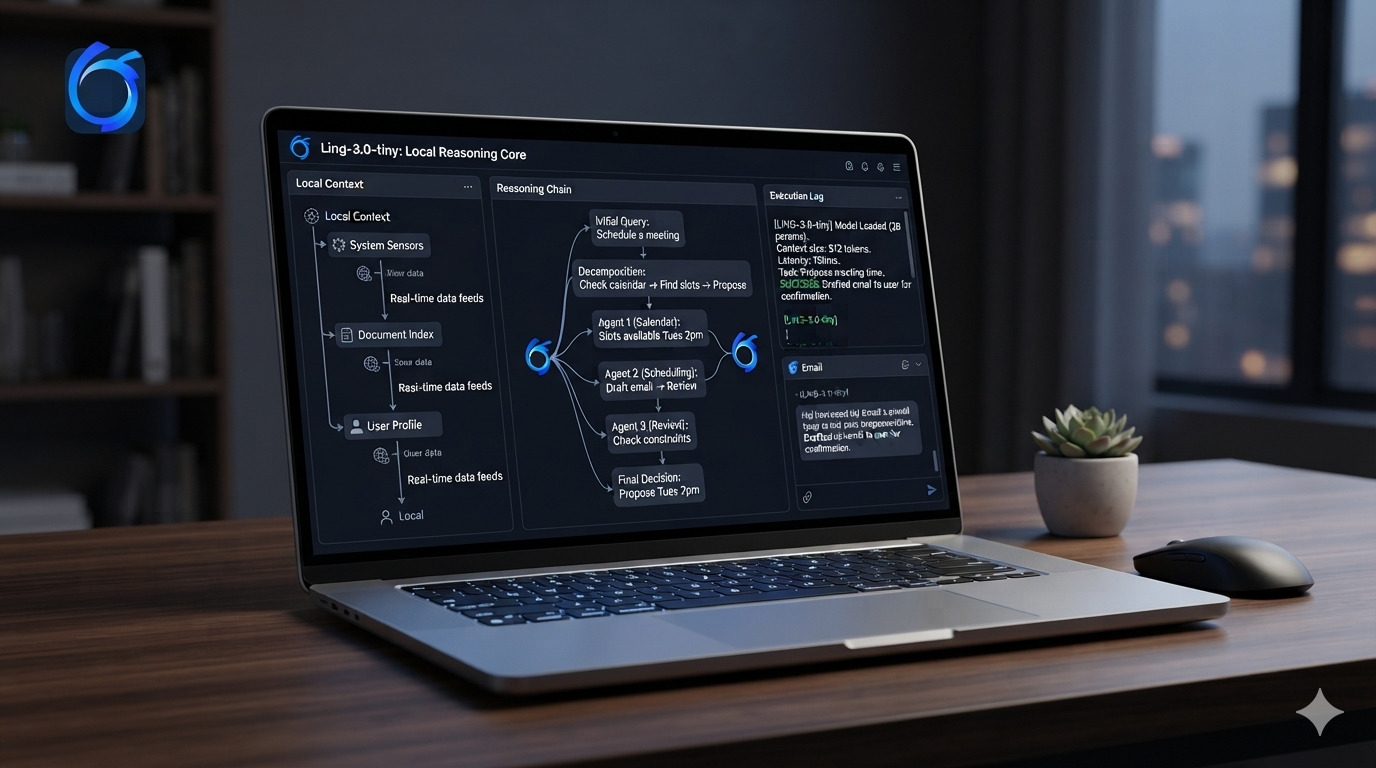
The next generation of AI models is not only about building systems with more parameters. It is increasingly about finding smarter ways to use fewer of them.
InclusionAI’s Ling-3.0-tiny is a good example of that shift. The model contains 7.9 billion total parameters, but only about 1.3 billion parameters are activated for each token. That mixture-of-experts design allows Ling-3.0-tiny to target reasoning, coding, instruction following, and agentic workloads without requiring the same amount of computation as a conventional dense model of similar total size.
The result is a model designed around an increasingly important idea in AI: useful intelligence does not always require massive infrastructure.
A 7.9B Model That Only Uses 1.3B Parameters at a Time
At first glance, 7.9 billion parameters may not sound particularly tiny by today’s standards.
But Ling-3.0-tiny is a sparse Mixture-of-Experts model. Instead of processing every parameter for every token, its architecture routes each token through a small subset of experts.
The model contains 128 routed experts, while each token activates only 8 routed experts together with 1 shared expert. According to InclusionAI, this results in approximately 1.3 billion activated parameters per token despite the model having 7.9 billion parameters in total.
That distinction is important.
The goal is not simply to create a smaller checkpoint. The goal is to make inference computationally cheaper while keeping access to a broader parameter pool.
This is one of the reasons sparse MoE architectures have become so important for modern language models.
Ling-3.0-tiny is effectively trying to get some of the capability advantages of a larger model while keeping the amount of computation needed for each token much lower.
Hybrid Architecture Built for Efficiency
Ling-3.0-tiny uses a hybrid attention architecture derived from the Ling-3.0 family.
The model alternates Kimi Delta Attention, or KDA, with Multi-Head Latent Attention, or MLA, in a 3:1 structure. In each four-layer block, three layers use KDA followed by one MLA layer.
This architecture is intended to improve efficiency, particularly for workloads where context length and repeated processing can become expensive.
Rather than relying exclusively on one attention mechanism, the model combines different approaches to balance computation, memory efficiency, and context handling.
That is especially relevant for agentic systems, where the model may repeatedly process instructions, tool outputs, code, files, and intermediate results.
Reasoning Can Be Switched On or Off
One of the most useful aspects of Ling-3.0-tiny is that it is not locked into a single response style.
The model supports native hybrid reasoning, allowing applications to choose between faster responses and more deliberate multi-step reasoning.
In the Hugging Face implementation, this behavior can be controlled with the enable_thinking parameter.
That makes the model more flexible than a system that always spends computation on extended reasoning.
For a simple request such as rewriting a sentence, generating a short response, or extracting a small piece of information, a fast mode can be preferable.
For a difficult coding problem, mathematical task, planning problem, or multi-step agent workflow, thinking mode can provide additional reasoning.
This makes Ling-3.0-tiny interesting not just as a chatbot model, but as a component inside applications that need to dynamically balance speed and intelligence.
Designed for AI Agents
Agentic AI is one of the main targets of Ling-3.0-tiny.
An agent does more than simply generate text. It may need to interpret instructions, plan a task, call tools, inspect results, write code, recover from errors, and continue until the objective is completed.
That puts very different demands on a language model compared with a traditional chatbot.
InclusionAI specifically positions Ling-3.0-tiny for agentic workflows, alongside coding, mathematical and scientific reasoning, general instruction following, and long-context understanding.
This is where the model’s sparse architecture becomes particularly attractive.
An agent can generate many intermediate tokens during a long task. Reducing the amount of computation required per token can therefore have a meaningful effect on total inference cost and responsiveness.
The architecture is essentially designed around the idea that an agent should be able to reason repeatedly without requiring a giant datacenter-scale model for every step.
Surprisingly Fast on Consumer Hardware
The most interesting part of Ling-3.0-tiny may be its local deployment performance.
In InclusionAI’s reported testing, the model reaches around 100–105 tokens per second with FP8 on NVIDIA DGX Spark.
On an Apple M4 Pro MacBook, it reaches approximately 86–90 tokens per second.
In the same M4 Pro testing, peak memory usage is reported at approximately 8.34 GiB with an 8K context length.
Those numbers are significant because they show the model is not designed exclusively for large multi-GPU clusters.
InclusionAI has specifically validated the model on NVIDIA DGX Spark and Apple Silicon hardware, showing that capable reasoning and agentic workloads can be run on considerably more accessible systems.
That makes Ling-3.0-tiny much more interesting to local-AI developers than a model that technically has open weights but still requires a large GPU cluster.
Artificial Analysis Results Highlight the Efficiency
In InclusionAI’s published evaluation, Ling-3.0-tiny receives an Artificial Analysis Intelligence Index score of 25 and an Artificial Analysis Agentic Index score of 16.
Artificial Analysis also measured output speeds above 160 tokens per second in its testing, with approximately 18 seconds of end-to-end latency for a 500-token response when reasoning time is included.
These numbers should be interpreted in context.
Ling-3.0-tiny is not trying to compete with the largest frontier models purely by total parameter count. Its appeal is the relationship between capability, computation, and deployment requirements.
A model with only 1.3B active parameters per token can deliver useful reasoning and agentic performance while remaining fast enough for local and resource-constrained environments.
That efficiency is arguably more important for developers building real applications than a raw parameter-count comparison.
Long Context Without a Massive Dense Model
Ling-3.0-tiny is also designed for long-context workloads.
The model’s official deployment examples support context lengths reaching 262,144 tokens using the recommended YaRN configuration.
That gives developers considerable room for applications that need to process large amounts of text, code, tool output, or conversation history.
Long context is especially useful for agents.
An agent may accumulate system instructions, previous actions, terminal output, documentation, source files, tool results, and user requests over the course of a task. A model with a large context window can retain more of that information without constantly summarizing or discarding older material.
The architecture’s combination of KDA and MLA is part of InclusionAI’s approach to making this kind of context processing more efficient.
Strong Fit for Coding
Coding is another major use case for Ling-3.0-tiny.
The model is explicitly evaluated across coding and agentic tasks, making it suitable for applications such as local coding assistants, programming agents, repository analysis, debugging workflows, and tool-based development systems.
Its reasoning capability is particularly relevant here.
A coding agent often needs to do more than produce a single block of code. It may need to inspect an existing project, reason about dependencies, make changes, run tests, analyze errors, and revise the implementation.
That workflow can generate a large number of model calls.
A smaller active parameter footprint can make these iterative workflows substantially more practical on local hardware.
Developers can combine Ling-3.0-tiny with terminals, code execution tools, file manipulation systems, and other APIs to build fully local development agents.
Multiple Deployment Options
The model is available in multiple precision formats, including BF16, FP8, and INT4.
That gives developers flexibility depending on the available hardware.
For server deployments, InclusionAI provides support through SGLang and a customized vLLM implementation.
The Hugging Face page also provides an Ollama setup for Apple Silicon, although the current instructions rely on an experimental Ollama branch rather than the standard official release.
The model can therefore fit into several different local-AI workflows instead of forcing developers into a single serving stack.
The official model is available on Hugging Face, and developers can also find the model through OpenRouter.
Open Weights and a Permissive License
Ling-3.0-tiny is released under the MIT license on Hugging Face.
That is important for developers who want to experiment with the model, integrate it into applications, or build their own inference infrastructure.
The combination of open weights, multiple precision formats, and local deployment support gives developers significantly more control than they would have with a model that only exists through a hosted API.
It also fits naturally into the growing ecosystem of open models that can be downloaded, quantized, fine-tuned, and deployed on hardware controlled by the developer.
Local AI Is Becoming More Interesting
The bigger story behind Ling-3.0-tiny is the changing economics of local AI.
A few years ago, running a capable reasoning model locally often meant accepting major trade-offs in speed or model quality.
Today, sparse architectures and more efficient attention mechanisms are changing that equation.
A 7.9B-parameter model with only 1.3B active parameters per token, an extended context window, native reasoning support, agent capabilities, and speeds approaching 90 tokens per second on an M4 Pro is a very different proposition from traditional dense language models.
It means developers can start thinking about AI agents that operate directly on a workstation instead of automatically sending every request to a cloud provider.
That can provide advantages in privacy, latency, offline operation, and potentially cost.
What Ling-3.0-tiny Is Best At
-
Local AI agents: Build assistants that reason, plan, call tools, and complete multi-step workflows directly on local hardware.
-
Coding assistants: Use the model for debugging, code generation, repository analysis, terminal-based development, and programming agents.
-
Fast reasoning applications: Switch between rapid responses and deeper thinking depending on the complexity of the task.
-
Long-context workflows: Process large documents, codebases, conversations, and accumulated agent context.
-
Resource-conscious deployment: Take advantage of sparse MoE computation, FP8, or INT4 weights to reduce hardware requirements.
-
Private AI applications: Run reasoning and agentic workloads locally when sending data to a remote API is undesirable.
The Limitations to Keep in Mind
Ling-3.0-tiny is impressive, but its small active parameter count does not mean it is equivalent to every much larger frontier model.
Some difficult tasks will still benefit from larger models with substantially greater compute budgets.
There is also an important difference between total parameters and active parameters. The model’s 7.9B total parameter count still affects storage and memory requirements, even though only about 1.3B parameters are activated for each token.
And while local inference is one of the model’s biggest selling points, the exact hardware requirements depend heavily on the precision, context length, serving framework, and workload.
The official Ollama support is also still experimental and currently limited to an Apple Silicon MLX workflow according to the model card.
So Ling-3.0-tiny should not be viewed as a universal replacement for every large language model.
It is better understood as a highly optimized model designed for a specific sweet spot: strong reasoning and agentic behavior with a comparatively small active compute footprint.
Why Ling-3.0-tiny Matters
The most exciting thing about Ling-3.0-tiny is not that it has 7.9 billion parameters.
It is that only a fraction of those parameters need to be active for each token.
That design allows InclusionAI to target a combination that has traditionally been difficult to achieve: meaningful reasoning capability, agentic functionality, long-context support, and fast inference on hardware that is much closer to what developers can actually own.
The model reaches around 86–90 tokens per second on an M4 Pro MacBook in the company’s reported testing while using approximately 8.34 GiB of peak memory at an 8K context length.
That is a strong indication of where local AI is heading.
Instead of asking whether a model can compete with the biggest system in the cloud, developers are increasingly asking a different question:
How much useful intelligence can I run locally, and how fast can I run it?
Ling-3.0-tiny is a compelling answer.
For developers building local coding assistants, autonomous agents, private productivity tools, and resource-efficient reasoning systems, this model deserves serious attention.
The future of AI agents may not always be a giant model running in a remote data center.
Increasingly, it may be a small, efficient model running right on your machine.
Ready to try it?
We may earn a commission — at no extra cost to you. Supports our independent testing.
Visit official site →Related articles

Meta Muse Glimmer 30B: The New King of Local AI Agents
Meta's new 30-billion parameter multimodal model brings agentic reasoning, native tool calling, and speculative decoding to consumer hardware. Here is everything you need to know.
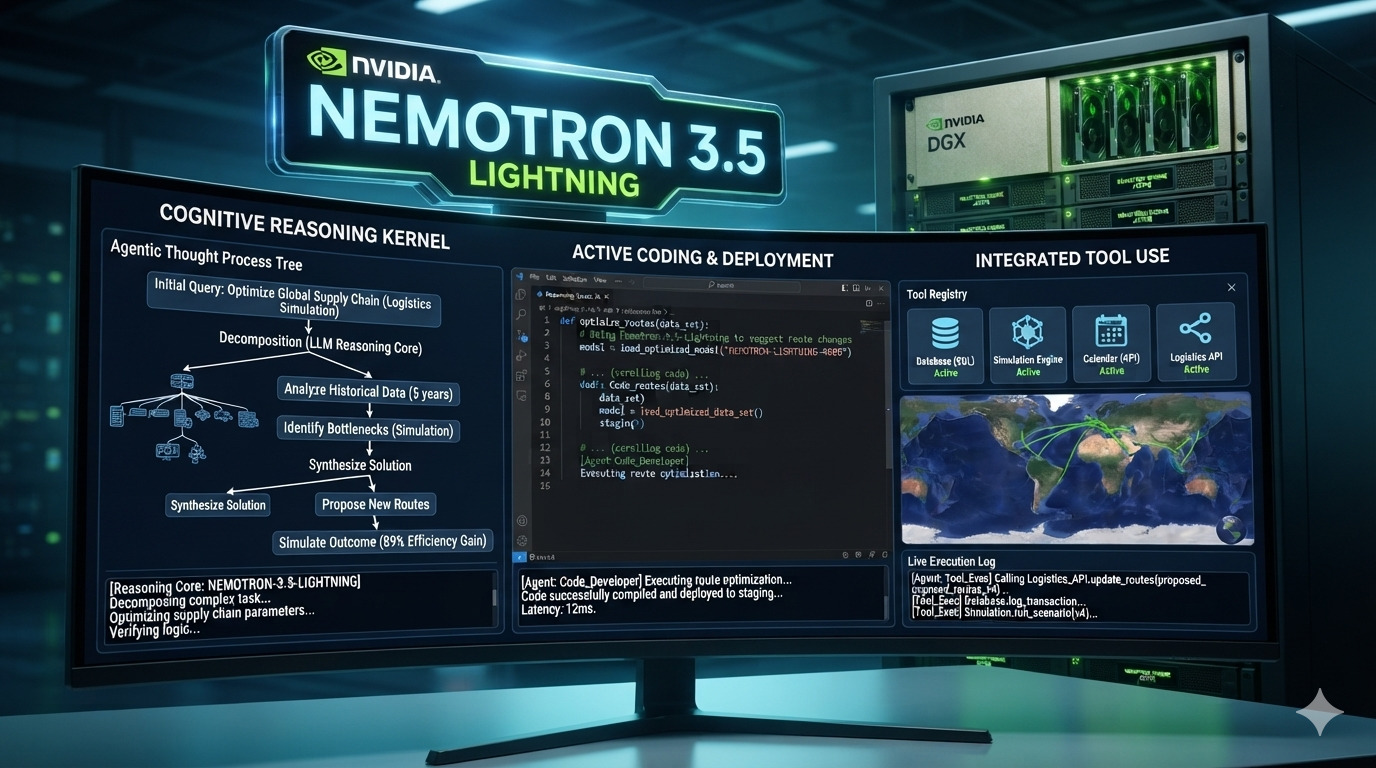
NVIDIA Nemotron 3.5 Lightning 30B: A 3B-Active Model Built for Long-Running AI Agents
NVIDIA’s Nemotron 3.5 Lightning 30B-A3B-NVFP4 combines a 30-billion-parameter hybrid Mixture-of-Experts architecture with only 3 billion active parameters, a 1M-token context window, NVFP4 quantization, and speculative decoding designed for fast agentic workloads, coding, reasoning, RAG, and long-running AI systems.
Kimi K3: The Open-Weight AI Agent With 2.8 Trillion Parameters and a Million-Token Context
Moonshot AI’s Kimi K3 is an open-weight multimodal agentic model with 2.8 trillion total parameters, 104 billion activated parameters, native vision, and a 1-million-token context window. Its combination of long-horizon coding, tool use, multimodal reasoning, and open weights makes it one of the most ambitious AI releases of 2026.