Qwen3-Coder-Next: The 80B Coding Model That Activates Only 3B Parameters
Qwen3-Coder-Next is Qwen’s open-weight coding model built specifically for autonomous coding agents and local development. With 80B total parameters but only 3B activated per token, a 256K context window, strong tool-calling, and support for long-horizon coding tasks, it delivers unusually high coding-agent performance without activating the full model on every inference.
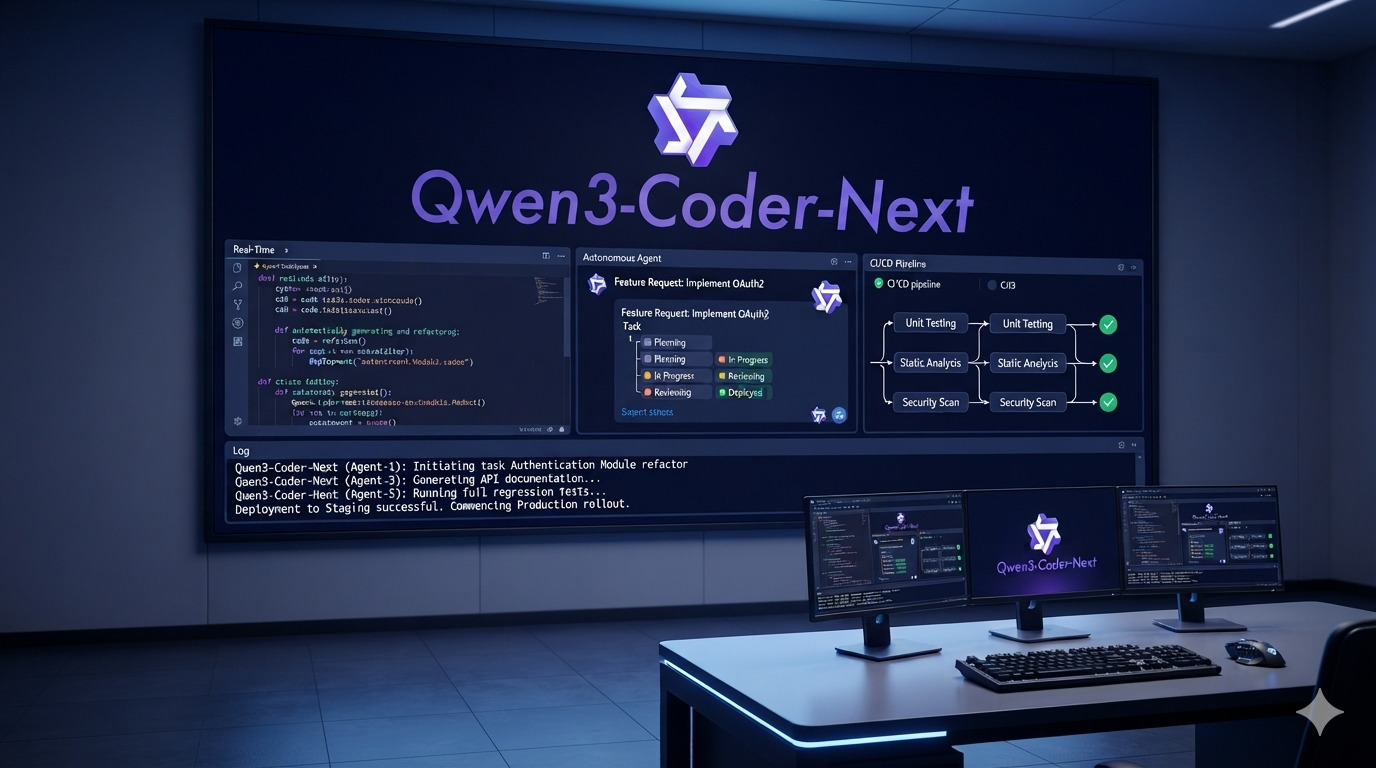
Coding models are becoming less interesting as simple autocomplete engines and much more interesting as autonomous software development systems.
Instead of merely asking an AI to complete the next few lines of code, developers increasingly want models that can inspect an entire repository, understand a task, call tools, modify files, run commands, recover from failures, and continue working across long sequences of actions.
That is the problem Qwen is targeting with Qwen3-Coder-Next.
Qwen3-Coder-Next is an open-weight language model designed specifically for coding agents and local development. What makes it particularly interesting is the architecture behind its size: the model contains 80 billion parameters in total, but only around 3 billion parameters are activated for each token through a Mixture-of-Experts design.
That gives it a very different profile from a conventional dense 80B model.
The goal is not simply to make a larger coding model.
It is to make a coding model that can deliver strong agentic performance while keeping active computation dramatically lower.
An 80B Model That Only Activates 3B Parameters
The headline specification of Qwen3-Coder-Next is easy to miss.
The model has 80 billion total parameters, but only 3 billion are activated during inference. Qwen describes this as a major efficiency advantage, noting that the model can achieve performance comparable to models with 10–20 times more active parameters.
That distinction between total and active parameters is crucial.
In a traditional dense transformer, essentially the full parameter set participates in every token prediction. Qwen3-Coder-Next instead uses a sparse Mixture-of-Experts architecture where the model selects a limited subset of experts for each computation.
The Hugging Face model card lists 512 experts, with 10 experts activated and one shared expert. The architecture also combines Gated DeltaNet and Gated Attention components in a hybrid layout across 48 layers.
The result is a model that can have a very large overall capacity without requiring every parameter to be computationally active for every generated token.
For coding agents, that is an especially useful design.
Agentic systems can generate a large number of tokens while repeatedly calling tools, inspecting outputs, editing files, and revising their plans. Reducing active computation can make that kind of workflow more practical.
Designed for Coding Agents, Not Just Code Completion
Many AI coding models are introduced with examples involving function completion, bug fixes, or code generation.
Qwen3-Coder-Next is aimed at a broader problem.
Qwen explicitly describes it as a model designed for coding agents, with improvements for long-horizon reasoning, complex tool usage, and recovering from execution failures.
That changes how the model should be evaluated.
A good coding agent is not simply one that can write Python or JavaScript.
It needs to understand a task, decide what to inspect, use the available tools correctly, evaluate what happened, and continue after something goes wrong.
For example, an agent might receive a task such as:
“Add authentication to this application, update the database schema, create the required API routes, modify the frontend, write tests, and fix any failures.”
That is not a single code-generation problem.
It is a sequence of interconnected decisions.
Qwen3-Coder-Next is designed around that type of workflow.
The 256K Context Window Changes Repository-Level Coding
One of the most important specifications is the model’s native 262,144-token context length, commonly described as 256K tokens.
A large context window is extremely useful for software development because modern repositories can contain enormous amounts of information.
An agent may need to understand:
- source files
- configuration files
- package manifests
- documentation
- test suites
- API definitions
- database schemas
- build logs
- command output
- previous tool results
A smaller context window forces an agent to repeatedly discard information and reconstruct its understanding later.
Qwen3-Coder-Next is designed to retain much more of that information in a single working context.
That does not mean developers should blindly send an entire repository to the model every time. Very large contexts still require considerable memory and compute, and Qwen recommends reducing the context length when hardware cannot comfortably support the full 256K setting.
But the ability to work with a quarter-million tokens gives coding agents considerably more room to reason about large projects.
Built for Long-Horizon Tasks
One of the most interesting parts of Qwen3-Coder-Next is its focus on long-horizon agent behavior.
Long-horizon coding means that the model is not expected to solve a task in one generation.
Instead, it might need to perform dozens of smaller actions:
- inspect the repository
- locate relevant files
- understand existing architecture
- modify source code
- run tests
- inspect errors
- modify the implementation
- run tests again
- update documentation
- verify the final result
The model therefore needs to maintain an evolving understanding of the task.
Qwen says Qwen3-Coder-Next has been trained to handle complex tool usage and recover from execution failures. That is an important capability because real software development is full of imperfect commands, failed builds, unexpected dependencies, and incorrect assumptions.
A model that can continue after a failed test is much more useful than one that only produces attractive code on the first attempt.
Tool Calling Is a Core Feature
Qwen3-Coder-Next also has explicit support for tool calling.
The official model card demonstrates function tools through an OpenAI-compatible interface and provides examples using both local serving frameworks and API-style clients.
This makes the model useful in architectures where the language model is connected to external actions.
For example, a coding agent can expose tools such as:
- reading a file
- writing a file
- applying a patch
- searching a repository
- running a shell command
- executing tests
- inspecting Git history
- querying a database
- starting a build process
The model can then decide when one of those tools is required instead of trying to solve everything through plain text.
That is the foundation of an actual coding agent.
Without tool use, an AI coding assistant is largely generating suggestions.
With tool use, it can participate in the development workflow.
A Model Designed for Local Development
Another major theme behind Qwen3-Coder-Next is local deployment.
The official Hugging Face page provides support for Transformers, vLLM, and SGLang. Qwen also notes support across local applications such as Ollama, LM Studio, MLX-LM, llama.cpp, and KTransformers.
That matters because coding agents often have access to highly sensitive information.
A local development agent may be able to see:
- proprietary source code
- API keys
- internal documentation
- private repositories
- database configuration
- deployment scripts
- customer information
Running the model inside infrastructure controlled by the developer can reduce the need to send those files to an external hosted service.
The model is released under the Apache 2.0 license, making it particularly attractive for developers and organizations that want more flexibility in how they deploy and integrate it.
Performance on Real Coding Tasks
The model’s evaluation results show why Qwen3-Coder-Next is generating interest among coding-agent developers.
The current Hugging Face model page reports a 70.6 score on SWE-bench Verified, 44.3 on SWE-bench Pro, and 36.2 on Terminal-Bench 2.0.
These benchmarks are interesting because they measure more than whether a model can produce syntactically valid code.
SWE-bench-style evaluations are focused on software engineering tasks drawn from real repositories, while terminal-oriented benchmarks test a model’s ability to operate through command-line environments and complete multi-step tasks.
That aligns much more closely with the type of behavior expected from modern coding agents.
The numbers should not be interpreted as meaning that Qwen3-Coder-Next is universally better than every larger coding model.
Different benchmarks measure different abilities, and results can vary significantly depending on inference configuration, tools, scaffolding, and agent design.
The more important point is that Qwen is targeting software engineering as an interactive agent problem rather than treating coding as ordinary text generation.
The Hybrid Architecture Is Doing a Lot of Work
Qwen3-Coder-Next is not simply a conventional transformer scaled to 80 billion parameters.
The model uses a hybrid architecture combining Gated DeltaNet and Gated Attention with Mixture-of-Experts layers.
The official model description lists:
- 80B total parameters
- 3B activated parameters
- 79B non-embedding parameters
- 48 layers
- 512 experts
- 10 activated experts
- 1 shared expert
- 2048 hidden dimension
- 262,144-token native context
This architecture is designed to balance model capacity with computational efficiency.
Gated DeltaNet provides linear-attention-style components, while gated attention layers retain more traditional attention mechanisms. The Mixture-of-Experts components then provide a large collection of specialized parameters without activating all of them for every token.
For an agentic coding model, this combination is particularly interesting because software engineering tasks can be extremely varied.
One step may involve natural-language planning.
Another may involve understanding a TypeScript error.
Another may require interpreting shell output.
Another may involve generating SQL.
The larger expert pool gives the model more capacity to specialize while sparse activation helps control the amount of computation used per token.
It Is Not a Thinking-Mode Model
There is another important detail that developers should understand.
Qwen3-Coder-Next supports non-thinking mode only. The official model card notes that it does not generate explicit <think></think> blocks in its output.
That means developers should not treat it like a model that exposes a visible chain-of-thought or selectable hidden reasoning mode.
Instead, its strength comes from its training for coding-agent behavior, tool usage, and long-horizon execution.
That distinction can actually simplify agent integration.
The model is designed to produce useful actions and responses without requiring developers to manage an explicit thinking/non-thinking toggle.
Connecting It to Existing Coding Agents
One of the biggest advantages of Qwen3-Coder-Next is that it does not need to be used inside a completely custom application.
Qwen describes compatibility with a variety of CLI and IDE environments, including tools such as Claude Code, Qwen Code, Qoder, Kilo, Trae, and Cline.
That means developers can experiment with the model inside existing agentic coding workflows rather than building an entire coding assistant from scratch.
For example, a developer can run Qwen3-Coder-Next through a local inference server and expose an OpenAI-compatible endpoint.
From there, an agent framework can send prompts and tool definitions to the model while handling the actual file system, shell, Git, and testing operations.
This architecture also makes it easier to swap models later.
The agent framework becomes the orchestration layer, while Qwen3-Coder-Next acts as the intelligence layer.
Running It With vLLM
For larger local deployments, vLLM is one of the officially supported serving options.
Qwen’s current documentation lists vLLM 0.15.0 or newer for Qwen3-Coder-Next and provides an OpenAI-compatible serving configuration.
A basic setup looks like this:
pip install "vllm>=0.15.0"
Then the model can be served using:
vllm serve Qwen/Qwen3-Coder-Next --port 8000 --tensor-parallel-size 2 --enable-auto-tool-choice --tool-call-parser qwen3_coder
The official instructions note that the default context is 256K and recommend reducing it to something such as 32K if the server cannot start because of memory requirements.
This is an important practical point.
A huge context window does not mean every machine can comfortably run the model at that context size.
SGLang Is Another Deployment Option
Qwen3-Coder-Next also supports SGLang.
The Qwen model card currently lists SGLang 0.5.8 or newer as required and provides an OpenAI-compatible serving example.
This gives developers another route for building high-throughput local or private inference infrastructure.
SGLang can be especially attractive for agentic systems that need structured generation, efficient serving, and tool-call support.
With both SGLang and vLLM available, developers have more flexibility when choosing the serving stack that best fits their infrastructure.
Quantized Versions Make Local Experimentation Easier
The standard Hugging Face repository is listed at 80B parameters and BF16 precision, which means the full unquantized model is not a casual download for an average laptop.
Fortunately, the Hugging Face model page provides access to a large ecosystem of quantized versions.
The model tree currently lists more than one hundred quantizations, with formats and implementations targeting tools such as llama.cpp, Ollama, and LM Studio.
Quantization can significantly reduce memory requirements, allowing developers with more modest hardware to experiment with the model.
That does not make an 80B-total-parameter model magically lightweight.
The 3B active-parameter design reduces compute per token, but the full model weights still have to be available in memory or across the devices serving it.
This is an important distinction when planning local deployment.
Why 3B Active Parameters Matter
The phrase “3B active parameters” may sound almost too small for a model intended to compete in serious software engineering tasks.
But that is exactly why the architecture is interesting.
Imagine two models.
One model has 30 billion active parameters every time it generates a token.
Another has 80 billion parameters available in total but activates only 3 billion for each token.
The second model can still have enormous total representational capacity while using a much smaller amount of computation for each individual prediction.
That is the core idea behind sparse Mixture-of-Experts models.
Qwen is effectively trying to maximize capability per active parameter.
For coding agents, this can be extremely valuable because agentic workflows may require long outputs and many repeated model calls.
The cost of each generated token matters.
Great for Repository-Level Work
Qwen3-Coder-Next becomes particularly interesting when applied to repository-scale engineering.
Consider a project with:
- a React frontend
- a Node.js backend
- a PostgreSQL database
- Docker configuration
- CI pipelines
- automated tests
- environment configuration
- hundreds of source files
A basic code completion model may be excellent at writing individual functions but poor at understanding how these components interact.
A coding agent built around Qwen3-Coder-Next can instead work through the repository as a sequence of actions.
It can inspect files, search for references, compare implementations, modify code, execute tests, inspect error messages, and continue.
The 256K context also gives it substantially more space to maintain repository-level information during difficult tasks.
That makes the model a much better fit for modern AI-assisted software engineering than a conventional autocomplete model.
Useful for Automated Debugging
Debugging is another area where agentic coding models can be particularly useful.
Suppose an application fails during deployment.
A traditional assistant might explain the error message if the developer copies it into a chat.
An agent can potentially go further.
It can inspect the configuration, locate the problematic file, reproduce the failure, make a change, rerun the command, and evaluate the result.
Qwen3-Coder-Next’s focus on tool usage and recovery from execution failures is directly relevant to that workflow.
The important part is the loop:
Understand.
Act.
Observe.
Correct.
Repeat.
That loop is much closer to how real developers solve complex problems.
Useful for Codebase Refactoring
Large refactors are also well suited to a long-context coding agent.
Changing an API name in one file is easy.
Changing it across an entire application is different.
A reliable agent may need to find every reference, update the implementation, modify tests, inspect configuration files, update documentation, run the test suite, and fix failures caused by the change.
The larger context and tool-use capabilities of Qwen3-Coder-Next make this kind of workflow much more practical than simply generating isolated code snippets.
The model can be used as the reasoning engine behind an automated refactoring workflow, while deterministic tools handle the actual filesystem and command execution.
But It Still Needs Good Agent Engineering
Qwen3-Coder-Next is powerful, but the model itself is not the entire coding agent.
The surrounding system still matters enormously.
A production-quality agent needs good:
- tool definitions
- repository indexing
- permission controls
- shell isolation
- context management
- error handling
- test execution
- file patching
- Git integration
- human approval workflows
A strong model connected to poorly designed tools can still behave badly.
Likewise, a well-designed agent framework can make a model significantly more useful by providing clear tool descriptions and reliable feedback.
The model should therefore be seen as one component of the agent stack rather than the complete product.
Security Still Matters
Autonomous coding agents can modify files and execute commands, which creates obvious security implications.
A model should not automatically receive unlimited access to a developer’s machine.
For serious usage, developers should consider sandboxing command execution, restricting filesystem access, isolating credentials, validating generated patches, and requiring approval for dangerous operations.
This becomes even more important when the model is connected to deployment systems, databases, cloud accounts, or production infrastructure.
Local inference can help with privacy, but local does not automatically mean safe.
The surrounding execution environment still needs to be designed carefully.
Qwen3-Coder-Next vs. a Giant Dense Model
The interesting comparison is not simply “80B versus 30B” or “3B versus 70B.”
The architecture makes direct parameter-count comparisons misleading.
Qwen3-Coder-Next has 80B total parameters but only 3B active parameters.
That means its computational profile is fundamentally different from a dense model with 80B active parameters.
The best way to think about the model is as a large pool of specialized knowledge with sparse routing.
Instead of paying the full computational cost of all that knowledge on every token, the model selects a smaller subset of experts.
That is the fundamental reason the model can target relatively efficient agentic deployment while maintaining a large total parameter capacity.
Open Weight Is a Major Advantage
Another reason Qwen3-Coder-Next stands out is that developers can access the model weights directly.
The Hugging Face release is available under Apache 2.0, giving users substantial flexibility to download, deploy, integrate, and build around the model.
That opens the door to private development environments where code never needs to be sent to a third-party hosted coding assistant.
Companies can potentially deploy the model within their own infrastructure.
Independent developers can experiment locally.
Researchers can study the architecture.
Tool builders can integrate it into custom agent frameworks.
And developers can create specialized systems around the model rather than being limited to a single vendor’s interface.
A Strong Model for the Local AI Movement
There is a broader trend behind Qwen3-Coder-Next.
Local AI is moving beyond chatbots.
Developers increasingly want AI systems that can actually perform useful tasks on their own infrastructure.
For coding, that means AI capable of:
- understanding repositories
- generating code
- editing files
- running commands
- reading test results
- fixing failures
- interacting with tools
- maintaining context across long tasks
Qwen3-Coder-Next is designed almost entirely around that future.
It is less about having a clever conversation with an AI and more about having a software engineering system that can take action.
What Developers Can Build With Qwen3-Coder-Next
-
Build autonomous coding agents: Connect the model to filesystem, shell, Git, test, and browser tools to create a local software engineering assistant.
-
Create private coding copilots: Run the model inside your own infrastructure for repositories that should not be uploaded to external AI services.
-
Automate bug fixing: Give the model access to logs, source code, tests, and command execution so it can investigate and iterate on failures.
-
Automate repository refactoring: Use its long context and tool-calling abilities to perform coordinated changes across large codebases.
-
Create local developer platforms: Combine Qwen3-Coder-Next with Ollama, LM Studio, llama.cpp, vLLM, or SGLang to build custom coding environments.
-
Power IDE and CLI assistants: Integrate the model into tools such as Qwen Code, Cline, or other agent frameworks that can communicate through OpenAI-compatible APIs.
-
Build software maintenance bots: Create systems that monitor test failures, inspect repositories, propose patches, and validate fixes automatically.
The Catch: Hardware Still Matters
There is an important misconception to avoid.
“Only 3B active parameters” does not mean Qwen3-Coder-Next is a tiny 3B model.
The model has 80B parameters in total.
That makes memory capacity a major consideration for local deployment.
The sparse architecture reduces the active compute per token, but the model weights still represent a large amount of data.
The official Qwen documentation therefore provides several deployment paths and recommends reducing context length when memory becomes a limitation.
Quantized versions can help substantially, but developers should still choose their hardware and inference configuration carefully.
For many users, cloud inference or a dedicated GPU server may remain easier than trying to run the model locally.
The Bigger Picture
Qwen3-Coder-Next is interesting because it represents a shift in what developers expect from coding models.
The old definition of an AI coding model was relatively simple:
Give it a prompt.
Get code.
The new definition is much closer to:
Give it a goal.
Let it inspect the project.
Give it tools.
Allow it to execute.
Let it test its work.
Let it recover from failures.
Then return a working result.
Qwen3-Coder-Next has clearly been designed for that second category.
Its 80B total parameter architecture, only 3B active parameters, 256K context, Mixture-of-Experts routing, tool calling, local deployment options, and strong software-engineering benchmark performance all point toward the same goal: making coding agents more capable without requiring every inference step to activate a gigantic dense model.
That is what makes Qwen3-Coder-Next different from a normal code-generation model.
It is not primarily trying to be the AI that writes the most impressive code snippet.
It is trying to be the model that stays useful while working through an entire software engineering task.
Final Thoughts
Qwen3-Coder-Next is one of the more interesting examples of how open-weight AI coding models are evolving.
The combination of 80B total parameters and 3B active parameters gives it an unusually attractive efficiency story. The 256K native context window gives it room to work on large repositories. Tool calling makes it suitable for autonomous workflows. Local deployment options make it practical for developers who want more control over their code and infrastructure.
Most importantly, Qwen is positioning the model around the realities of software engineering rather than simple code generation.
Real development is messy.
Commands fail.
Tests break.
Dependencies conflict.
Requirements change.
Files have to be inspected before they can be modified.
A useful coding agent has to deal with all of that.
Qwen3-Coder-Next is built with that reality in mind.
For developers looking to build the next generation of local coding assistants, repository agents, automated debugging tools, and AI-powered developer environments, it is a model worth watching closely.
The interesting question is no longer whether an AI can write code.
The interesting question is how much of the software engineering process an AI can reliably handle on its own.
Qwen3-Coder-Next is a strong step in that direction.
Ready to try it?
We may earn a commission — at no extra cost to you. Supports our independent testing.
Visit official site →Related articles
KAT-Coder-V2.5-Dev: The 35B Mixture-of-Experts Model Built for Autonomous Coding Agents
Kwaipilot’s KAT-Coder-V2.5-Dev is an Apache-2.0 open-weight agentic coding model with 35 billion total parameters and only 3 billion activated parameters. Designed for software-engineering agents, it supports up to 262K tokens of context and delivers strong results across SWE-bench, Terminal-Bench, PinchBench, and KAT-Code-Bench.
Top 10 AI Coding Assistants in 2026: The Ultimate Developer Guide
We tested 15+ AI coding assistants for 3 months. Here are the top 10 tools that actually boost productivity in 2026, with pricing, benchmarks and honest verdicts.

Cursor vs VS Code + Copilot in 2026: Which Should You Choose?
An honest, hands-on comparison between Cursor AI and VS Code with GitHub Copilot. Performance, features, pricing, and which wins for different developers.