Why Qwen 3.8 27B Just Changed the Math on Local AI Agents
With a 262K context window, native vision, and benchmark-beating SWE-bench performance on consumer hardware, Alibaba’s open-weights release shifts the center of gravity from cloud endpoints to local machines.
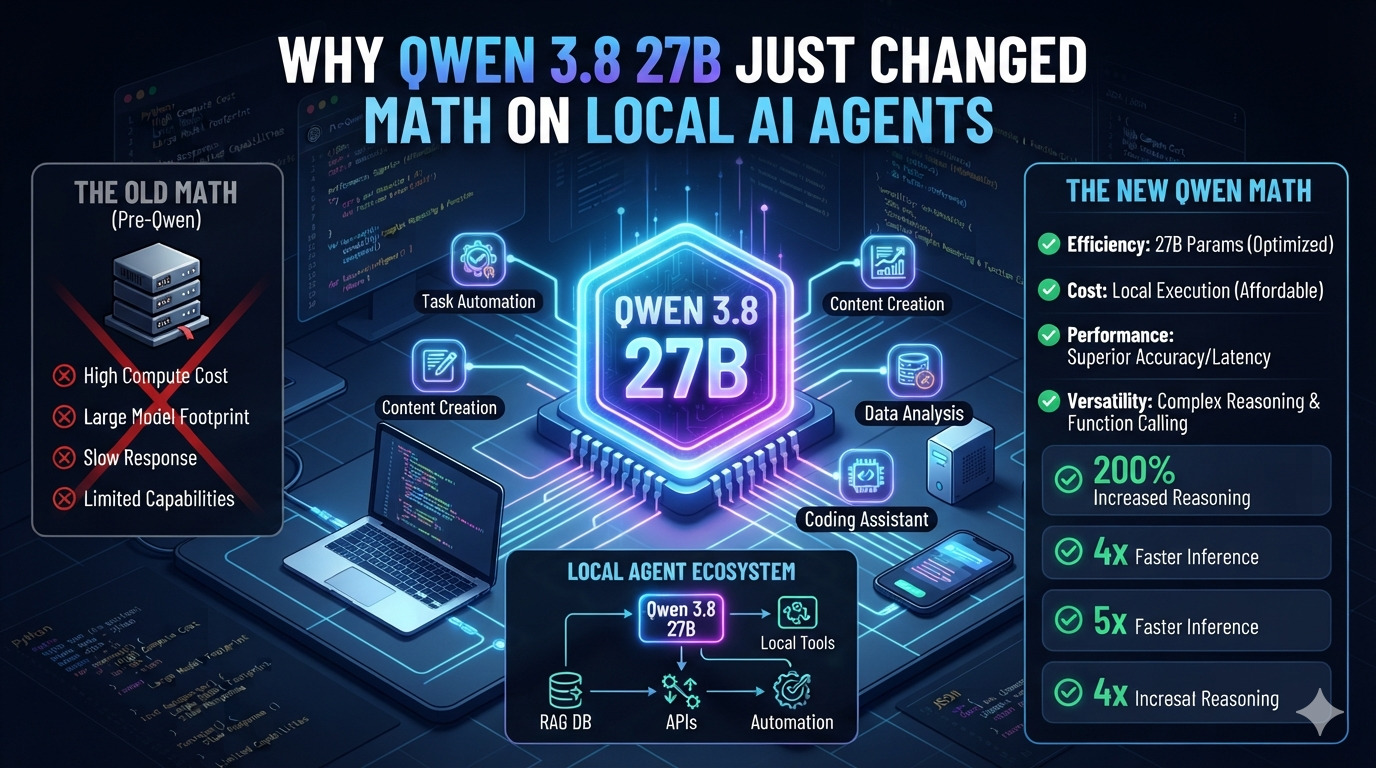
For the last two years, serious agentic coding meant paying the “API tax.” If you wanted a model capable of deep reasoning, reverse engineering malware, or analyzing multi-file repository diffs, you routed your requests to expensive cloud endpoints. Local models were great for autocomplete, but they routinely collapsed under the weight of true software engineering tasks.
With Alibaba’s release of Qwen 3.8 27B this week, that boundary just dissolved. The capability curve has shifted downward into consumer hardware, and it fundamentally alters the economics of how we build software locally.
The 27B Sweet Spot
The magic of Qwen 3.8 isn’t just its benchmark scores — it’s the form factor. At 27 billion parameters, it fits comfortably inside a 4-bit quantization (like a Q4_K_M GGUF), requiring only around 17 to 19GB of VRAM. This means anyone with a modern consumer GPU or a new AMD Ryzen AI Max+ workstation can run an elite coding agent entirely on-device, with zero latency and absolute data privacy.
But what truly separates this model is the architecture. It utilizes a 3:1 gated linear attention mechanism across its 64 layers, with 48 of those layers utilizing linear attention. Paired with a built-in Multi-Token Prediction (MTP) draft head for native speculative decoding, the result is blistering local inference speeds even when evaluating massive codebases.
262K Context, Zero API Cost
Under a full Apache 2.0 license, Qwen 3.8 27B ships with a native 262,144-token context window and a native vision encoder.
Think about what this unlocks. You can now stuff entire API documentations, massive stack traces, UI mockups, and complete architectural blueprints into your prompt. When relying on closed API endpoints, endless agent loops across a 200K+ context window rack up hundreds of dollars incredibly fast. Running it locally means the marginal cost of compute drops to zero. You are no longer penalized for giving your agent “too much” context.
The “Overthinking” Dial
Perhaps the most fascinating addition is the native reasoning_effort parameter. Qwen 3.8 allows you to dynamically control the model’s thinking depth per request, choosing between low, medium, or xhigh.
In practice, the default xhigh setting has led to hilarious instances of the model wildly over-analyzing simple boilerplate on consumer laptops. But when deployed in an autonomous CI pipeline, this control is exactly what you want. You can set the reasoning effort to low for rapid syntax linting, and crank it to xhigh when the model needs to trace a complex memory leak across five microservices. You now have a local intelligence that scales its compute burn to the complexity of the problem.
SWE-Bench and Real-World Taste
The benchmarks are unambiguous. Scoring 61.7 on SWE-bench Pro, Qwen 3.8 27B comfortably outperforms last year’s closed-weight titans like Opus 4.6 (which scored 53.4). It doesn’t just write functional syntax; it demonstrates taste in architecture. It understands how to autonomously navigate shell environments, read terminal logs visually, and drive tasks through to completion.
What to do about it
If your engineering workflow is still exclusively bottlenecked by cloud API rate limits, it is time to pivot:
- Pull the weights: Grab the quantized GGUF weights via LM Studio, Unsloth, or Ollama this week.
- Re-route your local agents: Point your Aider, Cline, or custom agent loops to your
localhostendpoint. Notice how much more aggressively you iterate when tokens are free. - Master the reasoning dial: Start experimenting with the
reasoning_effortsetting. Uselowfor standard boilerplate and reservexhighfor complex bug hunting. - Feed it everything: Stop artificially minimizing your prompts to save cents. Leverage the native 262K context to pass in full repository structures.
The era of paying a premium just to get reliable reasoning is ending. The developers who win the next cycle won’t just be the ones prompting the best — they will be the ones fully leveraging boundless, zero-latency local compute.
Related articles
Ling-3.0-tiny: A 7.9B AI Model With Just 1.3B Active Parameters for Fast Local Reasoning
InclusionAI’s Ling-3.0-tiny is a lightweight hybrid reasoning MoE model with 7.9B total parameters and only 1.3B activated per token. Built for coding, reasoning, agentic workflows, and local deployment, it can reach around 86–90 tokens per second on an M4 Pro MacBook while using roughly 8.34 GiB of peak memory at an 8K context length.

Meta Muse Glimmer 30B: The New King of Local AI Agents
Meta's new 30-billion parameter multimodal model brings agentic reasoning, native tool calling, and speculative decoding to consumer hardware. Here is everything you need to know.
NVIDIA Nemotron 3.5 Lightning 30B: A 3B-Active Model Built for Long-Running AI Agents
NVIDIA’s Nemotron 3.5 Lightning 30B-A3B-NVFP4 combines a 30-billion-parameter hybrid Mixture-of-Experts architecture with only 3 billion active parameters, a 1M-token context window, NVFP4 quantization, and speculative decoding designed for fast agentic workloads, coding, reasoning, RAG, and long-running AI systems.