DeepSeek-V4-Pro and the Economics of Brute-Force Reasoning
DeepSeek's newest frontier model didn't just top the SWE-bench leaderboards—it crashed the price of intelligence. Why the era of the 'single smart agent' is giving way to massive, disposable agent swarms.
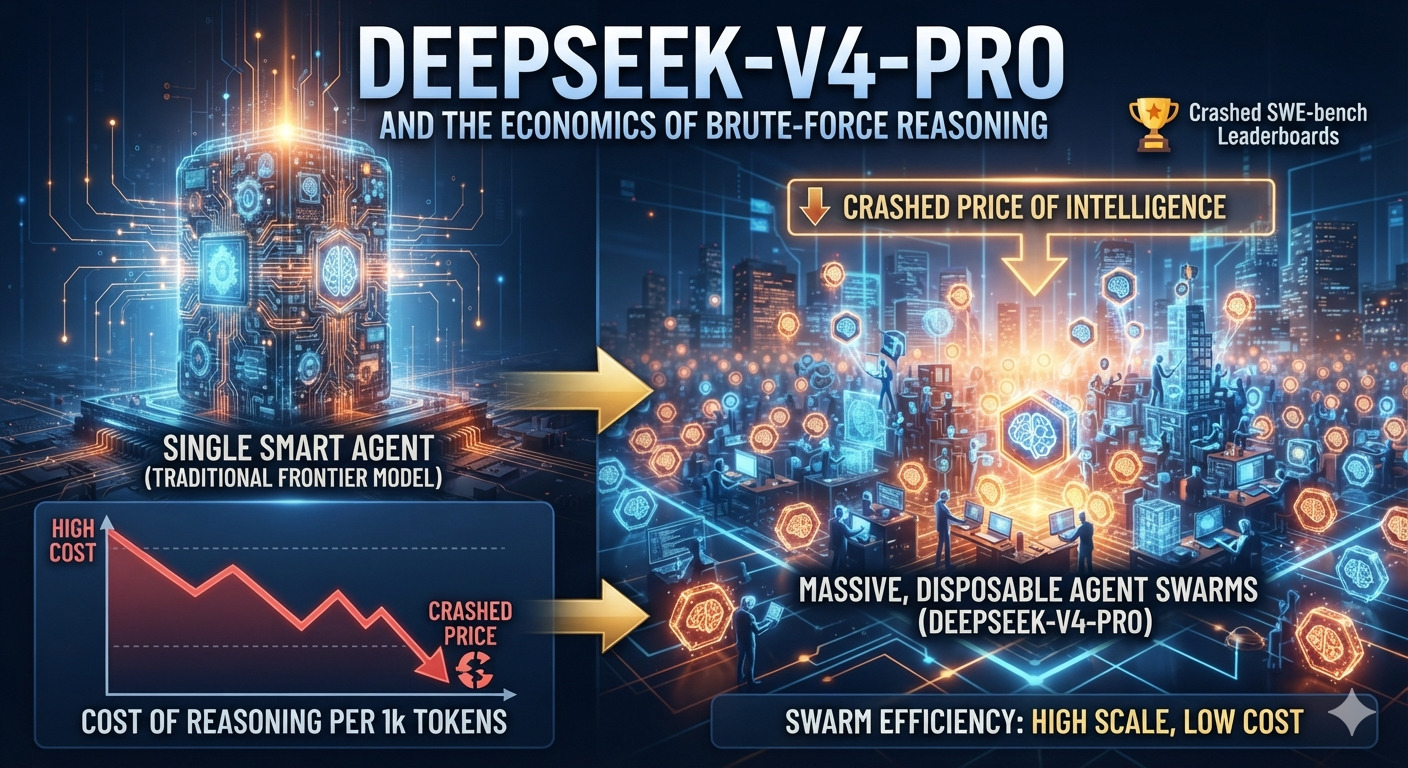
For the past three years, the AI industry operated under a universal law of physics: if you wanted elite, multi-step reasoning, you paid a premium. The frontier models that could reliably refactor a monolithic legacy backend or hunt down race conditions were walled behind APIs that cost enough to make CTOs sweat when scaled across an entire engineering floor.
Then DeepSeek dropped DeepSeek-V4-Pro this morning, and the physics broke.
While the headlines are focused on it dethroning the incumbent giants on SWE-bench Pro and HumanEval, the actual earthquake is the API pricing. DeepSeek has commoditized frontier-level reasoning, and it is going to completely rewrite how we design agentic workflows.
The End of ‘Zero-Shot’ Anxiety
When a model costs $15 per million input tokens, engineers write incredibly defensive agent pipelines. We prune context windows, we limit retry loops, and we try to force agents to get the answer right on the first or second try. We treat AI inference like a scarce resource.
DeepSeek-V4-Pro operates at a fraction of a cent per million tokens, powered by an insanely optimized, heavily sparse Mixture-of-Experts (MoE) architecture.
When intelligence becomes this cheap, you stop trying to engineer the perfect prompt for a single agent. Instead, you brute-force the problem. We are seeing early adopters shift from linear pipelines to Monte Carlo agent swarms. Got a tricky bug? You don’t ask the agent to fix it. You spawn 50 parallel agents, have them generate 50 different solutions, spin up 50 isolated sandbox environments to compile and test them, and merge the one that passes the test suite.
Native Test-Time Compute
Building heavily on the reinforcement learning breakthroughs of their older R1 lineage, V4-Pro integrates “test-time compute” deeply into its API layer.
Instead of just predicting the next token, you can allocate a compute budget directly to the prompt. If you give V4-Pro a complex architectural decision, it will spend invisible background tokens “thinking”—debating itself, constructing mental trees of logic, and exploring dead ends before it outputs a single word to the user. Because the underlying MoE routing is so efficient, it can afford to discard 10,000 tokens of internal trial-and-error in milliseconds.
The Death of the ‘Mid-Tier’ Model
The ripple effects of this release on the open-source and cloud ecosystem are brutal. The concept of a “routing agent”—where you send easy tasks to a cheap, dumb model and hard tasks to an expensive, smart model—is suddenly obsolete. If the smartest model in the world is also the cheapest, you just route everything to the frontier.
What to do about it
If you are building software or managing AI-driven engineering teams, your entire cost-benefit calculus changed today:
- Delete your context-pruning code: Stop writing complex scripts to compress your repository before sending it to an agent. Feed V4-Pro the entire codebase. The compute costs less than the time you spent writing the chunking logic.
- Embrace Swarm Architecture: Look into multi-agent debate frameworks. Rewrite your CI pipelines to allow the AI to try 10 different PR fixes in parallel rather than sequentially.
- Shift focus to Verification: If an AI can generate 50 solutions a minute, human code review is physically impossible. Your most valuable engineers are the ones who can write the deterministic integration tests that automatically grade the swarm’s output.
The developers who treat DeepSeek-V4-Pro like just another API endpoint will see moderate productivity gains. The developers who treat it like an infinitely scalable, nearly free workforce of disposable junior engineers will build the next generation of unicorns.
Related articles
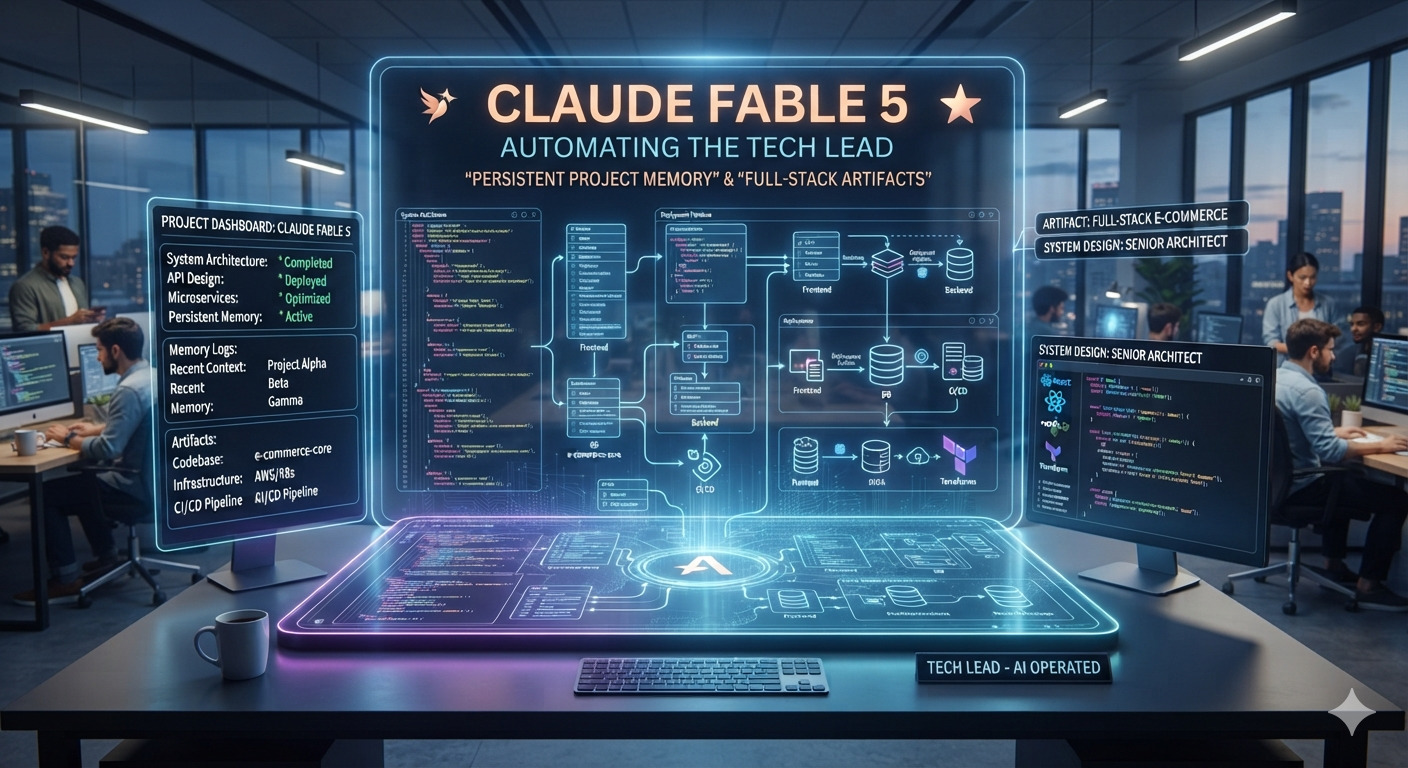
Claude Fable 5: Anthropic Just Automated the Tech Lead
While the rest of the industry races to the bottom on inference costs, Anthropic’s Claude Fable 5 introduces 'Persistent Project Memory' and full-stack Artifacts, shifting the AI from a disposable junior coder to a senior architect.

How AI Is Changing Software Development in 2026
Spec-driven development, agentic CI pipelines, and the quiet rewrite of the engineering career ladder — an analysis of how AI is actually changing the day-to-day of building software.

Best Free AI Tools in 2026: The Full No-Cost Stack
Every genuinely useful AI tool you can run today without entering a credit card — chat, search, images, code, audio, and automation — plus the free-tier limits that actually matter.